Although there’s still work to be done, some parts of my new book (no
title yet) are ready to share! I thought I’d give you all a taste of
the opening chapter. This book continues the story started in Love Lies Bleeding, introducing some new characters along the way. Fair warning, if you haven’t read Love Lies Bleeding yet, this excerpt contains spoilers. (And a trigger warning for anyone sensitive to violence.)
Spoilers Ahead
Mara was hungry and lonely. Hungry, she could take care of.
She was in London. She’d been there for what felt like months, but really was only a little over a week.
Nigel and Dominic were dead.
She’d killed them.
They’d deserved it, she reminded herself as her anxiety started to
spike. Dom had betrayed her, and both of them were threats to her and
Lee. Even more than vampires usually were.
Her mind, as it so often did, latched on to Lee. How was he doing?
Was he all right? Did he forgive her for leaving, for abandoning him?
It was for the best, all for the best. Always for the best.
An image of a bashed-in skull appeared in front of her. Nigel’s
unseeing eyes staring, judging. She blinked and Dominic was there, lying
on the ground, a dagger with a broken handle buried in his chest.
No, she muttered; not real.
But it was real. Or had been. She could still feel Nigel’s skull
shattering under the iron poker, could still feel the handle of the
blade breaking off as she tried to twist it in Dominic’s heart.
She knew it had happened; she just couldn’t believe it. Maybe because
it felt as though they were still with her. Or maybe because she hadn’t
bothered to check to make sure Dom definitely wouldn’t be coming back.
Either way, she’d felt as though she was being followed ever since.
Part of her hoped Lee had tracked her down, not only because she
desperately wanted to see him, but also because the alternative didn’t
bear considering.
Was Dominic still out there? Was he her ghost, her shadow, her
hunter? Leave it to him to keep chasing her from beyond the grave.
Or had all her victims broken free, the restless shades of her centuries of slaughter? She’d come home and unlocked their tombs.
The edges of her vision started tinting red. Right, she was hungry. Blood first, ghosts later.
The bars were always good for an easy meal. The streets were already
full of rowdy patrons heading to the next place, or getting into brawls,
or stumbling home, heads fuzzy and defenses down. It wouldn’t take much
to get one to follow her instead, to wander off into a dark corner of
the city where prying eyes didn’t reach.
She’d have to play the game a few times tonight, if she wanted enough
to be sated without taking too much from anyone. It wasn’t how she
usually fed—how she used to feed—but she was trying something new.
Feeding without hunting, without killing. Without the thrill. No matter
how much blood she drank this way she was always left empty. But she
survived, and it kept any more ghosts from haunting her.
Rising voices caught her attention: a man and a woman’s. The man’s
voice was laden with threat; the woman’s, distress. Mara’s pulse
quickened. Maybe she’d be playing a different game tonight, one where a
predator would get bled. It was always nice when people got what they
deserved. And so rare.
She approached the area where she’d heard the voices, making sure to
look innocuous. Just a girl out late, alone, quick steps and head
down—no threat to anyone. Or so they’d think—so they always
thought—until it was too late to think at all. But when Mara reached the
spot, an unlit path next to a park playground, she found a woman
standing calmly facing the other direction. No one else was around. Had
they already left, or had Mara misheard and gone to the wrong place? She
stopped, confused. The woman turned to look at her.
Let me know what you thought of it in the comments below. If you haven’t read Love Lies Bleeding, or my free stories “Blood Magic” and “Tooth & Claw,” download them now:
If you prefer paperback, use this link to order Love Lies Bleeding from
Bookshop – a portion of each sale goes directly to independent
bookstores, as well as to myself. Thank you for supporting indie! ♥
But first, on earth as vampire sent, Thy corse shall from its tomb be rent: Then ghastly haunt thy native place, And suck the blood of all thy race; There from thy daughter, sister, wife, At midnight drain the stream of life; Yet loathe the banquet which perforce Must feed thy livid living corse: Thy victims ere they yet expire Shall know the demon for their sire, As cursing thee, thou cursing them, Thy flowers are withered on the stem.
Lord Byron, 1812 (published in 1813)
In this post I'll be exploring the life and work
of George Gordon Byron, better known as Lord Byron: poet, adventurer,
freedom fighter, the original celebrity, cursed soul, granddaddy of
goths, and the first modern vampire (probably not literally).
If you weren’t aware, vampires weren’t always the charismatic, sexy,
human-seeming creatures we know them as these days. The vampires of
times past were generally monstrous, charmless, and often more like
zombies than what we now consider vampires to be (take a look at my post
A Further 5 Vampires You May Not Have Heard Of). That all changed with Lord Byron.
When Byron was born in 1788, he had a caul
over his face. There are many superstitions about cauls. Some believe
being born with one is lucky and the child is destined for greatness,
some believe the child will have second sight. In Romania the belief is
that those born with a caul become vampires after death.
Byron’s childhood was fairly traumatic by any standards. His father
was rarely around (and when he was, his presence didn’t improve
anything), his mother was an alcoholic, and his governess abused him. At
age 10, he inherited the title Baron Byron of Rochdale, along with the
family’s ancestral home, Newstead Abbey, which incorporated the ruins of
a Gothic monastery. At some point he found a human skull in the
building and took to drinking from it in front of friends, who he’d then
dare to do the same.
Portrait of Lord Byron by Théodore Géricault, 1811
As his popularity grew, Byron cultivated a “cult of personality”
based on his invented romantic and heroic image. He had portraits
painted of himself as different characters: Le Corsair, Scottish sailor,
Egyptian bandit. He adapted his personality, his clothing, and even the
way he spoke, to suit the occasion or who he was with. He presented
himself as a tragic outsider with a mysterious past, a character out of
his own books, and made sure never to let the persona slip.
Byron was one of the first to write about vampires in English. In his
poem”The Giaour” (quoted above) he tells of a man cursed to become a
vampire and destroy his own family. In notes with the poem, Byron
comments on the belief in the Levant, Greece, and Hungary of the Vroucolachas
(or Vardoulacha). After its publication, some expressed fear about
Byron’s hypnotic, or vampiric, ability to control his admirers with his
poetry.
This image Byron created of himself as the archetypal “Byronic Hero” would influence future literary characters such as Heathcliff (Wuthering Heights), Count Dracula, Batman, and Severus Snape, to name a few, as well as real-life celebrities and rock stars like Jim Morrison and Kurt Cobain.
In his unfinished work “Fragment of a Novel” (also known as “A
Fragment” or “The Burial: A Fragment) from 1819, Byron’s character,
Augustus Darvell, brings vampires into the modern age. Darvell is
wealthy, attractive, and blends easily into human society. Although
Byron never completed the story, according to a letter by his doctor and
‘frenemy,’ John Polidori, Byron was planning on having Darvell’s friend
bury him according to strange and ritualistic instructions, only to
come back later and find Darvell alive and wreaking havoc (including
seducing and killing the man’s sister).
Speaking of Polidori, Byron didn’t just write about vampires. he was
portrayed as one in the works of others. Polidori’s story “The Vampyre”
was strongly influenced by Byron’s ideas for the continuation of
“Fragment of a Novel” (Byron was also wrongly given credit for “The
Vampyre,” and Polidori struggled to correct the mistake). Besides
Byron’s influences, the main character “Lord Ruthven” was an
unflattering and exaggerated portrait of Byron. Ruthven is a sexual
predator who is calculating and cruel. He revels in sin and degradation.
Although he looks sickly and cadaver-like, he’s also compelling and
hypnotic. In the end Ruthven gets away with everything, while those
around him suffer.
Lady Caroline Lamb, a married woman Byron had an affair with and then ignored, got back at him through her novel, Glenarvon.
Again, a barely disguised Byron is portrayed as a vampiric (and
somewhat ridiculous) character, howling at the moon and dressing as a
monk. He seduces and ruins every woman he meets and betrays everyone
close to him. Unlike Ruthven, he gets his comeuppance when he’s
confronted by the ghosts of all the women he’s destroyed, and then
throws himself into the sea out of remorse. Lady Caroline is credited
with describing Byron as “mad, bad and dangerous to know”.
Byron and Polidori transformed vampires from the grotesque undead to
attractive and charming almost-humans. Bram Stoker was likely influenced
by Byron when he wrote Dracula, and ever since, vampires in
both print and onscreen are overwhelmingly “Byronic”: tragic,
mysterious, dark, brooding, and embodying (or inducing) lust. Literary
critic Tom Holland wrote in his 1999 essay “Undead Byron” that “vampires
remain recognizably Lord Byron’s descendants.” He also comments, “…the
modern genre of vampire fiction may be seen as perhaps the most vital
and enduring of all the varied expressions of Byronism.” As violent and
bloodthirsty as the modern vampire can be, fans are under their spell,
as much as Byron’s fans were under his.
Even in his own time, it didn’t go unnoticed that Byron had more than
a few vampiric qualities. People around him complained that he was
draining the life from them, and overshadowing them with his “almost
supernatural magnetism.” Critics claimed he hypnotized and subjugated
his followers. Byron himself felt he was cursed, pointing out that many
of the people closest to him suffered misfortune, or died tragically.
Amelia Opie, a woman Byron had charmed, claimed he had “such a voice
as the Devil tempted Eve with; you feared its fascination the moment you
heard it.”
And like a true vampire, Byron was immune to conventional life and the rules and judgments of polite society.
He was seductive and insatiable, not unlike vampires, although his
appetite was for sex, not blood. He was openly bisexual and had a
particular taste for married women, but not so particular that he didn’t
also sleep with admirers, servants, prostitutes, and his half-sister.
It was rare that anyone turned him down.
In a letter from 1819, Byron claimed to have no interest in vampires:
“I have besides a personal dislike to ‘Vampires,’ and the little
acquaintance I have with them would by no means induce me to reveal
their secrets.”
Reading this, I can’t help thinking that “little acquaintance” indicates that there was some
acquaintance. And what secrets of theirs was he keeping, exactly? It’s
not difficult to imagine that as he toured Europe and came into contact
with many of the cultures that had strong vampire folklore, he might
have encountered a creature that wasn’t quite human. At one point in his
travels, he was claiming that “spies” were following him through Geneva
and Flanders. Were they journalists looking for hot gossip to publish,
or maybe something more?
In 1823 Byron went to Greece to fight for Greek independence from the
Ottoman Empire. He spent 4,000 pounds (equivalent today to about
477,000 USD or 382,000 GBP) of his own money to refit the Greek naval
fleet. He also took command of a Greek unit of elite fighters.
Unfortunately, he fell ill with a “fever” on 15 February 1824.
Ironically, doctors bled him to treat the illness, which most likely led
to his death.
Byron died on 19 April 1824, aged 36. Some say his heart was cut out
and kept in Greece, where, to this day, he’s a national hero. In any
case, his body was returned to England. He was supposed to be buried in
Westminster Abbey, but the Dean of Westminster refused on the grounds of
Byron’s “questionable morality.” (They did add a memorial plaque to
Byron in 1969.) He was instead buried in the Church of St. Mary
Magdalene in Hucknall.
His death didn’t end the vampire rumours about Byron. Because people
kept insisting that his coffin was empty, in 1938– more than a century
after his death– the vicar of Hucknall agreed to open the casket. Byron
was inside, naked and well-preserved, The vicar stated:
‘Reverently, very reverently, I
raised the lid and before my eyes lay the embalmed body of Byron in as
perfect condition as when it had been placed in the coffin … his
features and hair easily recognisable from the portraits with which I
was so familiar. The serene, almost happy expression on his face made a
profound impression on me … I gently lowered the lid of his coffin – and
as I did so, breathed a prayer for the peace of his soul.’
And so Lord Byron rests in peace…or maybe not.
What do you think? Did Byron become a vampire, or just play one on the page? Share in the comments…
Celebrate Byron's legacy with some new vampire books:
If you prefer paperback, use this link to order Love Lies Bleeding from
Bookshop – a portion of each sale goes directly to independent
bookstores, as well as to myself. Thank you for supporting indie! ♥
In honour of the 125th anniversary of the publication of Bram Stoker’s Dracula, English Heritage is hoping to break the world record for “Largest Gathering of People Dressed as Vampires.” The current record involves 1039 people, and EH hopes to get 1897 participants of all ages (1897 being the year Dracula was published).
The event will take place at Whitby Abbey in northeastern England. Stoker spent time in Whitby, finding inspiration there for parts of Dracula.
Would-be vampires must adhere to a dress code: “full traditional
vampire fancy dress costume,” which includes black pants or a dress,
waistcoat and white shirt, a black cape or collared overcoat (lining
doesn’t need to be black), black shoes, and fangs over your top teeth.
There will also be performances of excerpts of Dracula and live music.
Details
Date: 26 May 2022 (World Dracula Day)
Time: 6 pm to 9 pm (record attempt will take place from 6:45 pm to 7:15 pm)
Cost: Tickets are free to anyone in costume, but they do need to be reserved in advance
If you prefer paperback, use this link to order Love Lies Bleeding from
Bookshop – a portion of each sale goes directly to independent
bookstores, as well as to myself. Thank you for supporting indie! ♥
Cheers,
Aspasía S. Bissas
(Originally posted on my official site. Follow me there: AspasiaSBissas.com)
No
judgments on where you read, but for the sake of books everywhere,
please don’t bend the cover back like this! Photo by Taryn Elliott on Pexels.com
Today is National Drop Everything and Read Day, which really should
be an international holiday, as far as I’m concerned. DEAR day happens
every 12 April, in honour of author Beverly Cleary’s
birthday, but can be celebrated all month and beyond. The goal is for
people to take time out of their day and spend it reading a book. Seems
like a great holiday to celebrate (I suggest your favourite warm drink
as the official accompaniment).
Looking for something you can read right now? I’ve got you covered…
If you prefer paperback, use this link to order Love Lies Bleeding from
Bookshop – a portion of each sale goes directly to independent
bookstores, as well as to myself. Thank you for supporting indie! ♥
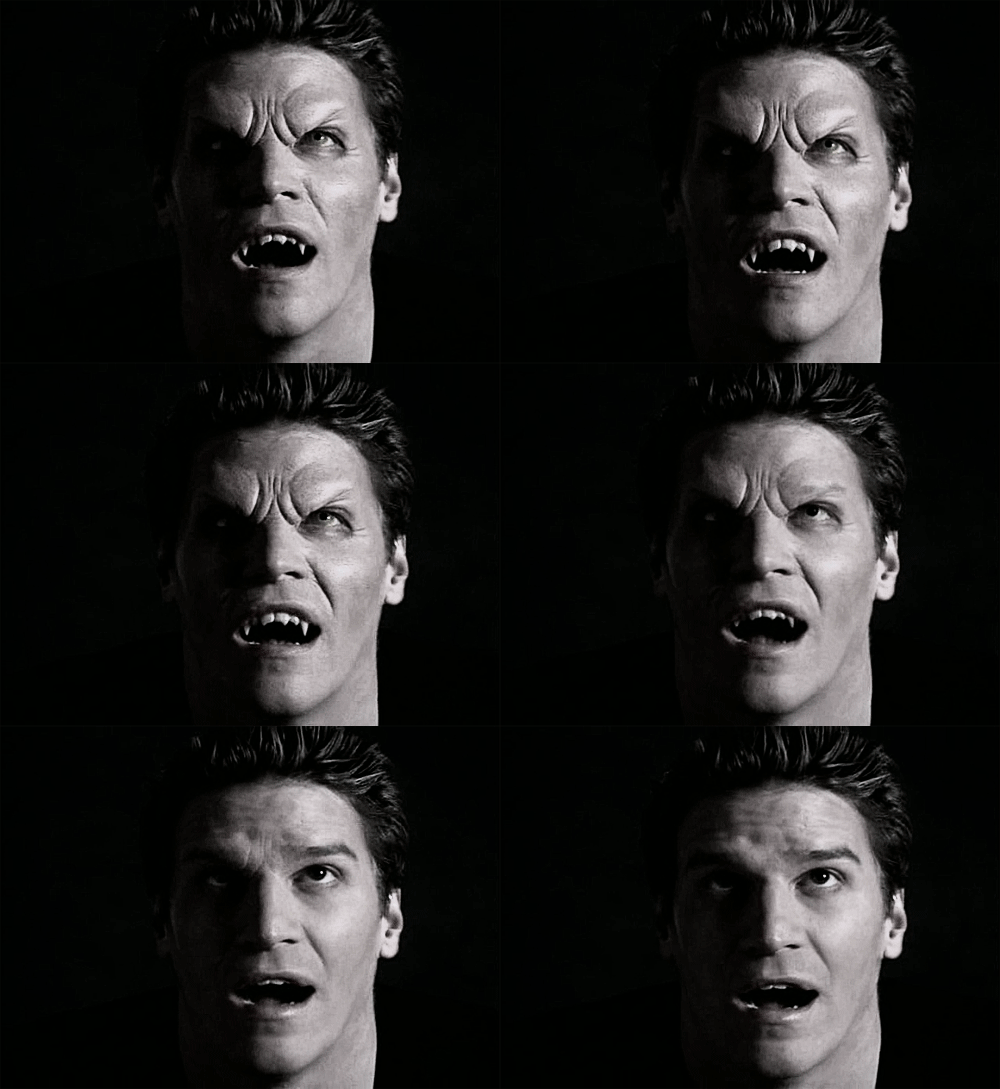
I’m still (re-)watching Buffy and Angel, and there’s something that’s been bothering me about Angelus…
Spoilers Ahead
First, we need some backstory.
in Buffy and Angel mythology, a vampire is made
when a vampire exchanges blood with a human before killing them. The
human’s soul leaves the body (presumably going off to the afterlife),
and the soulless shell reanimates, inhabited by a demon that looks like
the human, and has their personality and all their memories, but with an
aversion to sunlight and a thirst for blood.
Angelus started out like any other vampire, but after killing the
wrong girl he was cursed with a soul. Suddenly his body housed a demon
and a human soul. This unnatural combination led him to spend a hundred
years wallowing in guilt and remorse over what he’d done as a vampire,
before finally deciding to become a broody, but useful, member of
society. Oh, and he also started calling himself Angel.
But the curse had a loophole. If Angel were to ever experience a
moment of true happiness, the soul would go and Angelus would return in
all his murderous glory.
Over the course of both Buffy and Angel, we get to
see both Angel and Angelus, and much as I enjoy the dichotomy, something
about it bothers me. Angel is solitary, reserved, and thoughtful, but
ready to kick ass when necessary. Angelus, on the other hand, is cruel,
revels in violence, and is as meticulous in stalking and torture as the
most evil serial killer. So how is this the same person?
The shows simply claim that it’s the difference between soul and no
soul, but I’m not sure I buy that. The presence (or lack) of a soul
doesn’t completely change your personality. At one point Angel claims he
was a bad person as a human too, but from flashbacks we see he was
mostly a shiftless, carousing layabout and terrible son. That’s pretty
far from a cold-blooded killer (not to mention the other major
personality shifts we see between Angel and Angelus). The Buffy episode “Doppelgangland” even tacitly confirms that a vampire’s personality is basically the same as the human they inhabit.
When vampire Spike gets his soul back (earned, not cursed), his
personality doesn’t significantly change. He might be less likely to
finish off a mortally wounded human once he gets his soul, but if you
watched an episode featuring him without knowing which season it was
from, you wouldn’t necessarily be able to tell whether he has a soul or
not. Another vampire, Harmony, never gets a soul, but shows no
significant change in personality before and after becoming a vampire.
She even loves unicorns.
In the Angel episode “Eternity,” Angel is drugged so that he
feels a chemical high (which they call “happiness” for the sake of the
plot), Until the drug wears off he’s right back to being Mr.
Murder-Death-Kill, as though a switch were flipped. You’d think he’d
still be able to exert his own will, at least a little, to keep Angelus
from completely taking over. He didn’t even lose his soul that time.
Yes, it’s a TV show about vampires and demons, but it doesn’t make any
sense. Not to me, at least.
Maybe having a soul forced on him was traumatic for Angel, causing
his personality to fracture. Maybe the demon inside him is particularly
strong and malevolent. Maybe it really is only human guilt that keeps
Angel from totally going off the rails. Maybe I’m way overthinking this.
What do you think about Angel/Angelus and his split personality? Do
you have your own theories about the difference a soul makes? Share in
the comments…
If you prefer paperback, use this link to order Love Lies Bleeding from
Bookshop – a portion of each sale goes directly to independent
bookstores, as well as to myself. Thank you for supporting indie! ♥
Note to the reader: the following text is transcribed from a document
found in the crawlspace of an old row house in Montreal, Quebec. The
owner of the building sent it to a local historical association, who are
now sharing it in hopes that someone might have more information.
Interview with "Mara," a young woman who claims to be
a vampire
By J.S., editor at large
April 5, 1918.

J.S.: Could you please state your name for the record?
M: You can call me Mara.

J.S.: Is that your real name?
M: Real enough. It's the only one I have left.

J.S.: Could you tell me what you said when we met
earlier tonight?
M (does not reply)

J.S.: When we met, I asked what a young lady was doing
out alone in the middle of the night. How did you
respond?
M (smiles): I told you that I am a vampire.

J.S.: A vampire--like Mr. Stoker's Count Dracula?
M: As far as I know, he is fictional. I am not.

J.S.: What would you say to those who don't believe in
such creatures as vampires?
M: Your lack of belief doesn't make me any less real.

J.S.: How long do you claim to have been a vampire?
M: Most of my life.

J.S.: How long is that?
M: Isn't it impolite to ask a lady her age?

J.S.: Do you drink blood?
M: Of course.

J.S.: Where do you get it?
M: Wherever I can find it.

J.S.: From animals?
M: No.

J.S.: Do you have a reflection?
M (gets up and walks to the lavatory. She stares into
the mirror over the sink): It would seem so.

J.S.: Can you turn into a bat?
M (does not reply)

J.S.: How many other vampires are there?
M: More than your kind would care to consider.

J.S.: My kind? You mean mankind? Human beings?
M: Yes.

J.S.: Do you pay attention to human events? What do you
think of the Great War?
M: I wish I could be there, in the thick of it.

J.S.: Do you mean as a nurse?
M (laughs)

J.S.: Why do you want to be at the front? Isn't it
dangerous?
M: The danger is why. It's all death and chaos.
People die, people go missing--no one gives it
a second thought. Vampires do well in times of war.

J.S.: If that is the case, why aren't you there?
M: Someone else is there. He's looking for me. I do
not wish to be found.

J.S.: Who is there?
M: You should worry about the illness instead of
my acquaintances.

J.S.: The illness? Are you referring to the
Spanish Flu? There are rumours of epidemic.
M: The rumours are correct--the influenza is
spreading rapidly. I can smell it in the air.

J.S.: You can smell it? That must be handy.
M: It helps us to choose.

J.S.: What do you mean by 'choose'?
M: Most of us prefer blood from healthy specimens.

J.S.: And the rest?
M: We find those who don't have long. Some consider it
a kindness.

J.S.: Why are you telling me this?
M (does not reply)

J.S.: I don't have the Flu.
M: No, you have something deeper. In your bones.

J.S.: Oh, really? What does that smell like?
M: Like sour chalk and dry rot.

J.S.: Rot is right. You expect me to believe such
nonsense?
M: What about that ache that never seems to go away?
It's been getting worse, hasn't it?

J.S. (reluctant to respond)

J.S.: I have an appointment to see a doctor.
M: He won't be able to help you.

J.S.: How do you know?
M: They rarely can.

J.S.: Then what can anyone do for me?
M: I could prescribe you herbs, but they won't help,
either.

J.S.: A vampire and an apothecary? That is quite the
combination.
M: I learned my trade young and found that it
pays to keep humans healthy.

J.S.: Is that it, then? All you can offer are
ineffectual balms?
M: I can also offer you a kindness.

J.S.: You mean death.
M: Some prefer it to suffering.

J.S.: What if I refuse?
M: It's your choice. You have time to decide,
but not much.

J.S.: Where are you going?
M: I have other business to attend to. I'll return
in a fortnight. Tell me then what you've decided.

J.S.: Will it hurt?
M: I can make it so it doesn't.

M leaves and I finish recording our exchange.
I don't know why, perhaps for posterity.

I am unsure how to proceed.
Want to read more about Mara? Download my books now….
If you prefer paperback, use this link to order Love Lies Bleeding from
Bookshop – a portion of each sale goes directly to independent
bookstores, as well as to myself. Thank you for supporting indie! ♥
If you've read and enjoyed any of my books, please take a minute now to leave a rating or review (links below). And if you haven't read my books yet, now is the perfect time to start...
Paperback available from Bookshop – when you use this link, a portion of each sale goes directly to independent bookstores, as well as to myself. (It's also available on most other online book sites.)
Blood Magic
Myth and magic collide in this story about choices, transformation, and retribution.