Whenever a show has a devoted fandom there’s always going to be
something that, right or wrong, the fans aren’t happy about. The big
controversies on Buffy and Angel were the late
additions of two new characters, namely Dawn and Connor. Now that I’m
re-watching both shows, I’m looking at both characters with fresh eyes,
wondering whether they deserved the hate.
Dawn
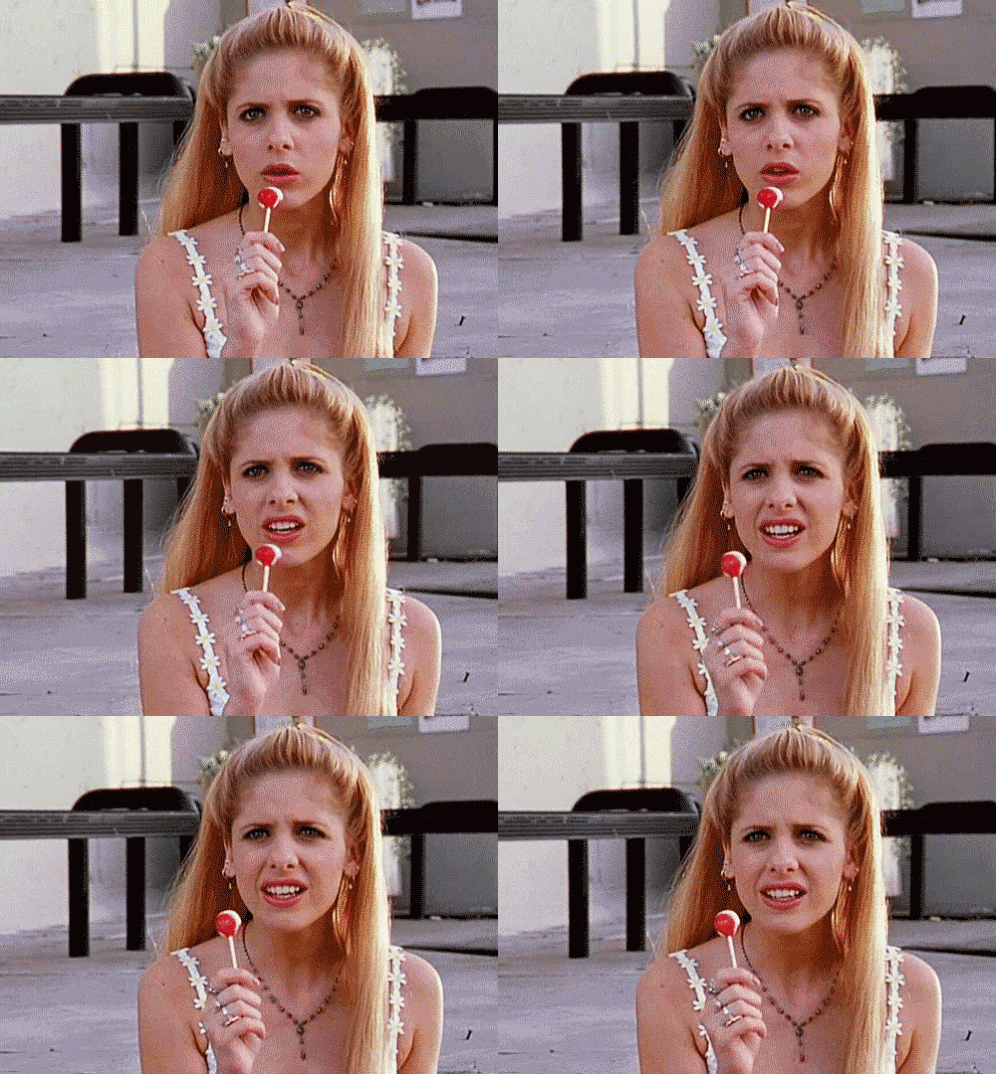
Dawn was introduced at the end of the first episode of Season 5. “Buffy vs. Dracula”
(a great episode, by the way). Her introduction was really well done,
first with hints and foreshadowing going back as far as Season 3, then
with her unexpected appearance in the episode. After years of being an
only child, Buffy suddenly has a sister, and everyone acts as though
she’s always been there.
After some perfunctory hinting that Dawn is this season’s Big Bad, it
comes out that she’s actually a mystical, dimension-unlocking Key, put
into human form by some monks with too much time on their hands, and
given to the Slayer as a sister for protection from the Hell God
(Glorificus/Glory), who needs the Key to get back to her hell dimension
before her window of opportunity closes. Got all that?
Yeah, it’s a lot.
I really believe all the planning around Dawn went into the
character’s concept, and very little into the execution. Dawn is
supposed to be fourteen when she shows up, but she’s written like she’s
eight. It’s both painful and annoying to watch this teenager smiling
with her mouth plastered in ice cream. Or interrupting Buffy’s training
sessions because she’s “bored.” Or threatening to tell their mom that
Buffy slayed in front of her. At fifteen, Buffy, Willow, and Xander were
fighting monsters, trading quips, and hanging out at the Bronze. Their
characters were funny and interesting. But somehow at fourteen Dawn is
too young to be left alone without a babysitter.
And yet by season six Dawn manages to get worse, alternating between
whining that no one spends time with her, and screeching for everyone to
get out of her room. Maybe this is a realistic portrayal of teenagers
(I have my doubts), but nobody watches TV for realism. If we’re supposed
to sympathize with Dawn, the writers made it really difficult,
especially when she shows no empathy for what anyone else is going
through.
(I want to add that none of this is the fault of Michelle
Trachtenberg, the actress who played Dawn. She did a decent job, but
just didn’t have much to work with.)
By the seventh and final season, Dawn’s over her annoying phase, and
even proves herself useful and capable– but she also fades into the
background. Season five was supposed to be the show’s last season, but
since it ended up extended for another two years, I don’t think they
really knew what to do with her once she was no longer The Key. Overall,
I think the Dawn character had a lot of room for improvement, and the
writers/producers repeatedly dropped the ball. The show could have been
just as good, or better, without Dawn.
Connor’s origin story begins in season 3, and is almost as convoluted
as Dawn’s. When two vampires hate each other very much (after spending
centuries together as a couple), and unknown forces conspire to get them
back together for a night, sometimes the mommy vampire finds herself
nine months later going into labour in a back alley, where she finally
just stakes herself to get the whole thing over with.
Connor is the human-ish son of Angel and Darla, both vampires, one
with a soul. His existence is cause for much excitement, mostly by
nefarious cabals who generally want to kill the kid. Despite Angel and
co.’s best efforts to protect baby Connor, he ends up in the hands of
Angel’s longtime enemy, a vampire hunter named Holtz. Stuck between
letting Holtz take the baby or watching Connor fall into the hands of
those who will definitely kill him, Angel chooses the lesser of two
evils. Holtz escapes with the baby by jumping through a portal to the
darkest hell dimension: Quor’toth. The portal is then sealed behind them
with no way to open it.
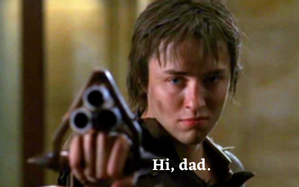
Angel tries to get Connor back, but realizes it’s impossible. Once
Angel accepts that he’ll never see his son again (it takes only a few
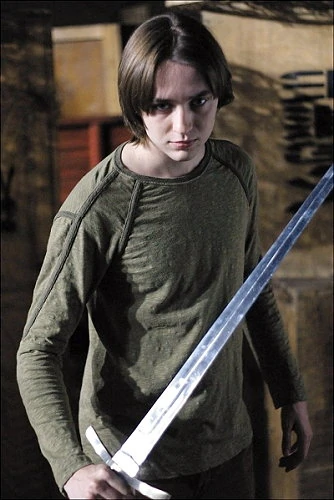
days, apparently), another portal opens and out comes an armed teenager
wearing a skin suit and trophies made of body parts. I’m not gonna lie–
it’s pretty epic.
We soon find out that not only did Connor survive Quor’toth, but he
can kick some serious ass. Besides impressive fighting skills, he has
super speed and strength. He can easily jump on a moving bus and he’s
got a vampire’s sensitive hearing (but none of the drawbacks, like a
need to consume blood or intolerance to sunlight).
I thought he was an excellent addition to the show, but a lot of
people disagreed. Connor was so hated by some fans that when rumours
started about bringing Spike to Angel,
people started urging (there may have been a petition– I can’t
remember) the producers to kill off Connor and bring on Spike. Note:
none of the characters actually had to die to add Spike to the cast. It
should also be noted that the dislike of Connor spilled over into people
specifically targetting Vincent Kartheiser, who played Connor. The
actor did an awesome job and deserved none of what was directed at him.
This is why fandoms have a bad reputation.
I never understood why people found Connor annoying. Yes, the
character did a lot of questionable– and some downright wrong– things
(same as pretty much all the other characters, I might add). What haters
didn’t seem to get (or care about) is that Connor is a deeply
traumatized kid. He was raised in a hell dimension, by a man who
(rightfully) hated his father and manipulated him into wanting to kill
Angel. And that’s only the start of what Connor went through. He’s a
tragic character who manages to never be boring. He also undergoes a
fair bit of character development, and a redemption that continues in
the comic books (meanwhile Dawn in the comic books goes back to being
annoying, but with added recklessness). Watching these episodes again,
I’m finding I like and sympathize with Connor even more now. It’s too
bad he was hated– he could have pulled off his own show.
In the end, my opinion on these characters hasn’t really changed. Dawn didn’t improve Buffy,
even though her initial season included one of the best villains ever.
Meanwhile, Connor, despite having one of the cringiest storylines (him +
Cordy = ew), was a great character and a solid addition to Angel. But what did you think of Dawn and Connor? Share in the comments…
If you prefer paperback, use this link to order Love Lies Bleeding from
Bookshop – a portion of each sale goes directly to independent
bookstores, as well as to myself. Thank you for supporting indie! ♥
True love is a forever thing– especially for vampires. Or it can be,
anyway. These TV couples’ stories left us wondering, but I’d like to
believe they got their happily ever after. Here are three vampires who
were (probably) lucky in love…
Spoilers Ahead
Mick St. John and Beth Turner, Moonlight
Mick and Beth, Moonlight
Mick (vampire) and Beth (human) have a complicated relationship. Beth
has a boyfriend and Mick saved Beth’s life as a child and has been
keeping tabs on her ever since. It’s a tale as old as time. But as the
show goes on, their feelings for each other grow and turn into something
else (and just as complicated). There’s a lot of back and forth about
whether a vampire-human relationship could even work, and when the
series was cancelled it ended ambiguously on a kiss between Mick and
Beth. These two have a real connection, even if their fears cloud their
feelings at times, so I think they have a solid chance to make it work.
The show hinted at the potential for a vampire cure, so Mick could
eventually become human. He could also turn Beth. Love finds (fangs?) a
way.
Is this love?: 8/10
Jessica and Hoyt, True Blood
Jessica and Hoyt, True Blood
Although it might not seem like it, Jessica (vampire) and Hoyt
(human) have a lot in common. Both had traumatic childhoods with
domineering, manipulative parents. Both have quieter, somewhat
innocent/naive personalities with rebellious sides. Both also have to
cope with situations they have no control over, and neither really knows
where they fit into the world. When they meet each other, it’s love at
first sight. They did try to make it work for a while, but there were
too many things working against them, including Hoyt’s mother and
Jessica’s vampire nature. Their breakup was both inevitable and
necessary, giving them a chance to figure out who they were. They
eventually reunite, and even though we don’t get to see how their life
together plays out, chances are they make it work (at least, they’d
better make it work after all the screen time the producers devoted to
their wedding in the series finale).
Is this love?: 9/10
Alex and Hal, Being Human
Hal and Alex, Being Human
Okay, this one might be cheating since both characters are human by
the end of the series, but sparks started flying while Hal was a
vampire, so I’m counting it. Although both are attracted to each other,
their budding relationship is cut short when another vampire takes it
upon himself to kill Alex (and then gives her blood to an unsuspecting
Hal to drink). Hal is horrified at what’s happened, and when he finds
out Alex is still around in ghost form, he promises to get revenge for
her murder. With nowhere else to go and few people to talk to (thanks to
being invisible to humans) Alex ends up moving in with Hal. Their
opposing personalities make them something of an odd couple: Hal is
precise, compulsive, and terrified of losing control; while Alex is
carefree, no-nonsense, and takes things as they come. But the real
hindrance to a relationship is that one of them is incorporeal (and it
doesn’t help that the other one is constantly fighting his blood lust).
The series (officially) concludes with an interesting twist that has all
supernatural beings become human again, finally giving Hal and Alex a
real chance at a life together.
Is this love?: 8/10
What other vampires have a shot at love? Share your thoughts in the comments…
Want more vampires in love (and otherwise)? Get my books!
If you prefer paperback, use this link to order Love Lies Bleeding from
Bookshop – a portion of each sale goes directly to independent
bookstores, as well as to myself. Thank you for supporting indie! ♥
It’s that time of year again– the Smashwords end-of-year e-book sale has begun! Get Love Lies Bleeding for 25% off (and as usual, Blood Magic and Tooth & Claw
are free)! The holidays are a great time to catch up on your reading
(or maybe even complete a challenge). Download my books and get started
right now….
Chances are when you think of vampires you’ll think of Spike, Nick Knight, Miriam Blaylock, or any of the other fanged creatures-of-the-night that populate modern culture, including Mara from Love Lies Bleeding.
The vampires we’re familiar with are (generally) human looking,
powerful, often charismatic and attractive, with a thirst for blood and a
dislike of stakes. But that wasn’t always the case. History and
folklore are full of types of vampires that are nothing like what we’ve
come to expect. Here are five examples…
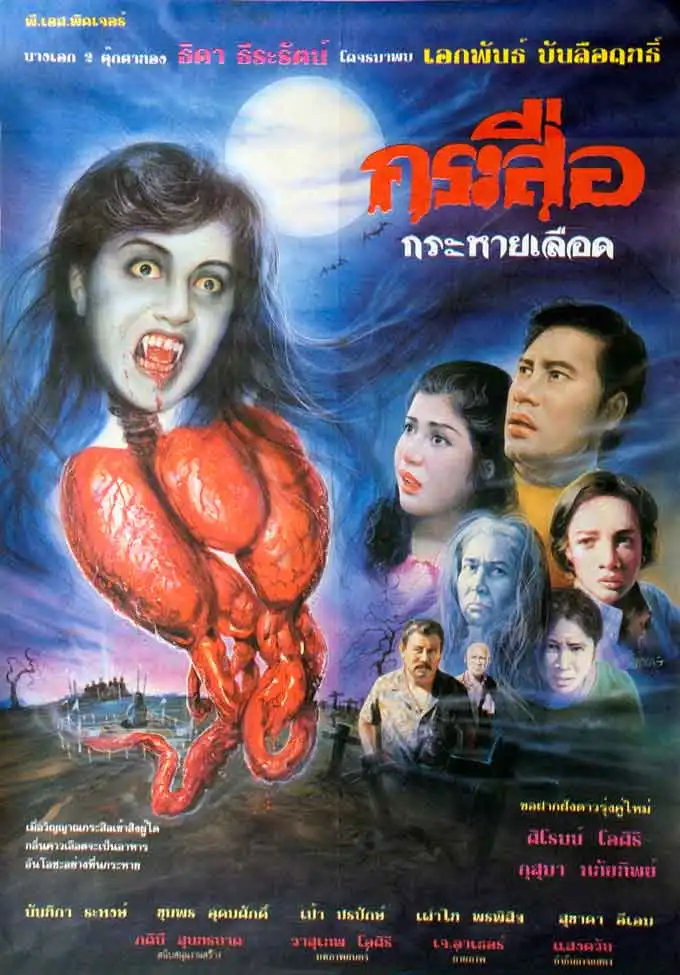
Krasue
Similar to the penanggalan
of Malaysia, the krasue is a type of ghostly vampire from Thailand that
preys on chickens and cattle. The krasue has the face of a beautiful
young woman (or sometimes an old woman), but instead of a body she has
hanging organs and entrails. She’s also luminescent, and can be
considered a form of will o’ the wisp.
Like most vampires, she has fangs, and like most ghosts, she moves by
floating. A common belief is that women who live sinful lives are cursed
to become krasue after death (or that the curse will be passed on to
their daughters and granddaughters). Another belief is that eating food
contaminated by krasue saliva or flesh will turn someone into a krasue.
And, as has been the case countless times throughout history, women in
small communities acting “strangely” were/are suspected of being witches
and monsters, or in this case– of becoming krasue at night. Krasue are
always hungry, seeking out blood or flesh to consume. If blood isn’t
available they’ll settle for rotting food, corpses, or feces. The krasue
needs to reattach to her headless body before dawn, so destroying the
body also destroys the krasue. Other ways to kill krasue include
cutting the organs and entrails off or burning her. A krasue can be
prevented from entering the home by surrounding it with something spiky,
like bamboo, which the krasue will avoid in order not to get her
entrails caught. There have been several krasue sightings in Thailand in
recent years, most– but not all, debunked.
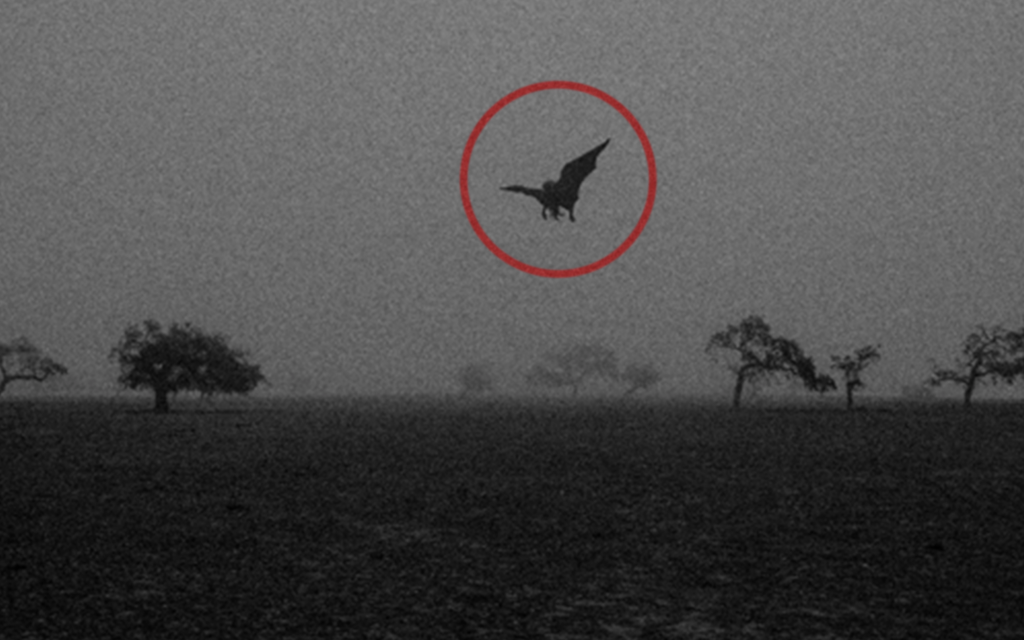
Manananggal
The manananggal is from the Philippines and is similar to the
penanggalan and krasue in the way it separates from the lower half of
its body, trailing intestines behind. Unlike the other two, the
manananggal has large, bat-like wings, and can be either male or female
(although they’re usually female). Another name for manananggal is
“tik-tik,” which is the sound the tiktik birds make as they accompany
the manananggal when they’re flying. Apparently the sound gets fainter
the closer they get, a tactic meant to confuse their victims. One
becomes a manananggal either by inheriting the condition, performing a
ritual, or surviving a manananggal attack. While they have fangs,
manananggal perch on roofs and use their long, proboscis-like tongues to
suck the blood from sleeping victims. They’re also known to eat flesh
and organs. Preferred prey is pregnant women, fetuses, and newlyweds
(particularly the grooms, as manananggal is said to have been left at
the altar). Like many vampires, manananggal hate garlic and holy water;
unlike most vampires they also can’t stand salt, vinegar, spices,
daggers, and the tails of stingrays. To keep a manananggal away from
your house, leave pots of uncooked rice, salt, or ash around. To kill a
manananggal, spread salt, ash, or crushed garlic on the detached lower
half. The top half won’t be able to reattach and will then die at
sunrise.
ETA: a commenter let me know that the manananggal can also transform
into a wild pig (!), and that “Oftentimes, a woman suspected of being
one is asleep during the day.” Thanks for the extra info!
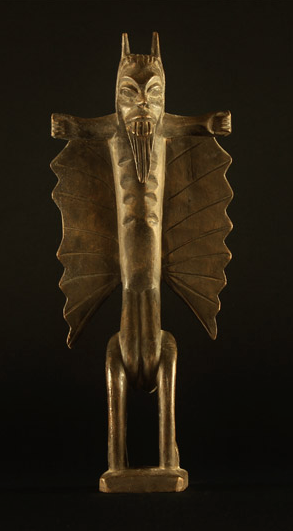
Sasabonsam
Ashanti Sasabonsam/Asanbosam figure, via Into the Wonder
Sasabonsam, also known as Asanbosam, is a vampiric being in the
folklore of the Akan people of southern Ghana, Cote d’Ivoire, and Togo.
Instead of feet they have iron hooks, which they use to dangle from
trees in order to attack from above. They also have iron fanged teeth
and bat-like features, including pointed ears and 6 metre- (20 foot-)
long wings. Sasabonsam are territorial creatures, feeding on anyone who
enters their forests. They eat flesh, as well as drinking blood, and
they can infect people with a wasting illness (a common theme in vampire
lore) with just a look. There is a claim that a man killed one by
“fatally injuring it,” but I can’t find more details about it. Because
of their hook feet, they can’t move well on the ground, so in theory you
could get away from a Sasabonsam if you can run fast enough to get out
from under the trees before they can grab you. Then again, it’s said
that they like to play with their victims, like cats sometimes do with
mice, so running might not help much.
Pricolici
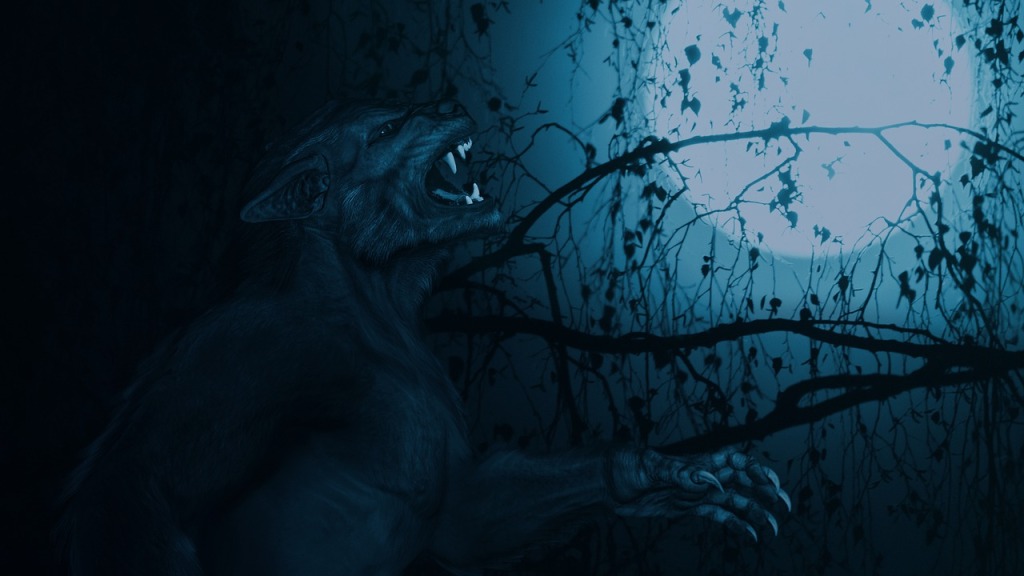
A creature from Romanian folklore, the pricolici is a hybrid
vampire-werewolf (together at last!) Some claim they are undead souls
risen from the grave in wolf form. Others say that pricolici are
werewolves in life, who then rise after death as vampires. Men who are
cruel or violent in life are likely to become pricolici after death. In
any case, pricolici are especially vicious undead that enjoy hurting the
living.
Greece (influenced by the myths of neighbouring Slavic countries)
brings us our final (for now) vampire: the vrykolakas. Interestingly,
while vrykolakas is generally considered to be a vampire, its name (from
the Bulgarian vǎrkolak) means werewolf, and by modern
definitions it’s closer to a zombie than a vampire. Vrykolakas don’t
decay after death, but their bodies become swollen with blood, giving
them lifelike ruddy complexions. They generally roam around wreaking all
sorts of havoc, including causing epidemics. Vrykolakas sometimes sit
on victims as they sleep, crushing or suffocating them. It was also
believed (and still is in some places) that they would knock on doors,
calling the names of people inside; if anyone opened the door, they
themselves would die within a few days and become a vampire. One could
also become a vrykolakas by living a sacrilegious life, being buried in
unconsecrated ground, or eating the meat of a sheep that had been
injured or killed by a wolf. Like the pricolici, it was also thought
that a werewolf could become a vampire after death, retaining wolf-like
fangs, hairy palms, and glowing eyes. The vrykolakas eats flesh rather
than drinking blood, and it has a particular fondness for livers
(possibly with a nice Chianti). The longer they are allowed to roam and
feed, the stronger they become. To kill a vrykolakas, the body needs to
be destroyed, which is done by impaling, beheading, dismembering, or
cremation. Destroying the body has to be done on a Saturday, which is
when the vrykolakas is believed to rest. During the Great Famine
of 1941-1942 in Greece, so many people died that burial on consecrated
ground became impossible. Families started pre-emptively destroying
bodies so that their loved ones wouldn’t become vrykolakas.
Have you heard of these vampires? Which do you think is scariest? Tell me in the comments…
If you prefer paperback, use this link to order Love Lies Bleeding from
Bookshop – a portion of each sale goes directly to independent
bookstores, as well as to myself. Thank you for supporting indie! ♥
As soon as I heard about Morbius coming out, I was excited to see it. And then the reviews started coming in.
Spoilers Ahead
I should mention that I haven’t read the comic book, so I won’t be
comparing the movie to it at all. My SO has read it and he said he was
never a fan of the character, who started out as a Spider-Man villain
and ended up being more of a neutral character. If movie Morbius is
anything like comic book Morbius, I can see why he wasn’t a fan.
Morbius is about Michael Morbius, a man with a chronic (and
ultimately deadly) disease that he’s vowed to cure. In pursuit of a cure
he creates artificial blood that has somehow saved more lives than
penicillin, but still can’t save his own. So he crosses over to the
unethical side of research, importing (sigh) vampire bats from Costa
Rica and using them to create a serum that when fused with his own DNA
will, theoretically, finally be the cure he’s been looking for.
And then it goes horribly wrong. Oh no– what an unforeseen tragedy that no one could have foreseen.
It wasn’t just the story and main character that were underwhelming.
Starting with the opening shot of scenery suddenly interrupted by a
helicopter entering from behind the camera, I felt like I’d seen this
movie a thousand times before. From the cinematography to the acting to
the writing– it was all just so pointless. There’s no tension or mystery
at all, no artistry; and the whole thing seems rushed, like everyone
involved was just trying to get it over with. Twilight was by no means a good movie, but at least it tried.
By the way, I’m no fan of Twilight, but I’d rather watch the entire movie series in one sitting than sit through Morbius again. Bring on the sparkles.
The only bright-ish spot in the entire movie was Michael’s best
friend, Lucian AKA Milo (played by Eleventh Doctor, Matt Smith). Milo
also has the disease Michael has and is desperate to be cured, taking
the serum in secret. Michael then immediately treats Milo as though he’s
a monster/pure evil because he doesn’t want to go back to a painful
life and early death. At least Milo embraces being a vampire and exudes
some menace, unlike mopey Michael. At no point does Michael consider
finding a way to live with being a vampire, like finding a source of
human blood without the need to kill people (blood bank blood maybe?
Idk). He immediately concludes that his serum is a curse with
intolerable side effects (i.e., becoming a vampire) and it’s best to
just give up rather than try to find a way to make it work. No wonder
Milo isn’t on board.
The movie ends with a predictable twist and the worst post-credit scenes I’ve seen. I’m honestly not sure why Morbius
was made; it doesn’t add anything to vampire lore, and I can’t see it
adding anything worthwhile to the Spider-verse (like Spider-Man, Morbius
is a Marvel character licensed by Sony, so technically not part of the
MCU). Milo isn’t even around anymore to possibly make things more
interesting in future movies.
If you’re a stickler for watching everything Marvel related, then go ahead and watch Morbius. If you want to see a decent vampire flick, then go watch Lost Boys, or What We Do in the Shadows, or yes, even Twilight (at least you can laugh at it). The critics were right, Morbius sucks, and not in a good way.
What did you think of Morbius? Share in the comments…
If you prefer paperback, use this link to order Love Lies Bleeding from
Bookshop – a portion of each sale goes directly to independent
bookstores, as well as to myself. Thank you for supporting indie! ♥
Cheers,
Aspasía S. Bissas
(This was originally posted on my official website: AspasiaSBissas.com. Follow me there...)
Love Lies Bleeding‘s readers know that main character Mara is both a vampire and a botanist. Trained when she was still human, she continues to study plants and have a garden. This post is ninth in a series exploring Mara’s plants. Are you interested in botany, gardening, or plant lore? So are some vampires…
Please note: Medicinal uses are given for informational purposes only. Always consult a medical professional before diagnosing or treating yourself or anyone else.
Please also note: Nettle is known as stinging nettle for a reason. See "Caution" below.
Botanical Name:Urtica dioica
Common Names: Stinging nettle, common nettle, nettle leaf, stinger, burn nettle, burn weed, burn hazel, feuille d'ortie, slender nettle, tall nettle, wild nettle. (Not to be confused with dead nettle, Lamium spp.)
History: Native to Europe, temperate Asia, and parts of northern Africa, nettle can now be found throughout the world. It grows abundantly in areas that receive regular rain, such as the Pacific Northwest, and locations that have been disturbed by humans (e.g., ditches and fields). The German idiom "sich in die Nesseln setzen," or to sit in nettles, means to get into trouble. The medical term for hives, "urticaria," comes from the Latin word for nettle: Urtica (from urere, "to burn"). It has been used as medicine, food, tea, and as a raw material for textiles since ancient times.
Language of Flowers Meaning: Rudeness, coolness, scandal, pain, slander, cruelty, protection (no two sources I found gave the same meaning).
Cultivation: Perennial. Nettle needs moist, rich soil (it's also an indicator of fertile soil wherever it grows wild). Start seeds indoors about 4 to 6 weeks before the last frost date, or sow seeds directly in spring or autumn. Transplant hardened seedlings in spring, spacing plants 30 cm (12 inches) apart. Make sure to grow nettle away from high-traffic areas in your garden. The plant grows 1 to 2 m (3 to 7 ft) tall in summer and dies back in winter. Harvest leaves in early spring (don't use once the plants have flowered) and roots in autumn. Nettle spreads easily via rhizomes, so if you'd like to grow it but don't want it taking over your yard, keep it contained with a barrier around its roots (if it gets invasive, regular and persistent tilling can help get it under control; otherwise, you may need to resort to herbicides). Add nettle leaves to compost as a source of nitrogen (or make compost tea). You can also forage for nettle in green spaces and open woodland (just be sure it hasn't been sprayed with pesticides or steeped in car exhaust).
TIP: Aphids love nettle. Grow nettle to keep aphids away from other garden plants (like roses).
Uses:
Medicinal: The fresh plant is a traditional spring tonic. Fresh or dried leaves and the powdered root have been used to treat disorders of the kidneys and urinary tract, and for sore muscles, osteoarthritis, rheumatism, and gout. The leaves are also used for skin conditions, to treat anemia, and to reduce hay fever. There is some evidence that nettle lowers both blood sugar and blood pressure. Some folk practitioners still practice Urtication, or flogging with nettles, to treat arthritis and rheumatism, and to increase circulation (although this has been shown to be effective, before you try it keep in mind that Urtication has also been used as a sentence for criminals).
Hair Care: A tea made from nettle leaves can be used as a hair rinse to add strength and shine. Some people believe it also stimulates hair growth, but that is purely anecdotal.
Culinary; Nettles are rich in Vitamins A, B, and C, as well as iron, potassium, calcium, and protein. Use young plants picked in spring (plants that have flowered or gone to seed contain gritty particles that can irritate the urinary tract and kidneys). The sting can be removed by cooking or drying nettles, or by soaking them (I can confirm that cooking and drying works, but I'm hesitant to try the soaking method-- please let me know if you have, and how it went). Fresh nettle can be used like spinach or other greens, or made into chips or pesto. Dried or fresh leaves and flowers can be made into tea. You can also brew beer from young nettles.
Fun Fact: There's a World Nettle Eating Championship, where people compete to see who can eat the most fresh nettles. Those with a low pain tolerance need not apply.
Wildlife: Nettle provides food for the larvae of several species of butterflies and moths. Ladybugs (a beneficial garden insect) also prefer laying their eggs on nettle. When harvesting, watch out for eggs and caterpillars (a curled leaf can be a sign of a resident) and avoid damaging those leaves.
Textiles: Nettle has been used to make a linen-like fabric for at least 3,000 years, and unlike some plants (looking at you, cotton) nettle doesn't need pesticides. Some modern European manufacturers are starting to produce nettle fabric again.
This short video demonstrates how to make nettle fabric:
And this video shows how to make paper from nettles:
Natural Dye: Nettle produces yellow dye from its roots and a yellow-green or grey-green hue from its leaves.
Caution: The leaves of most nettle species are covered in hollow needle-like hairs that inject histamine and other irritating chemicals into the skin when touched, causing a stinging sensation and contact dermatitis (known as contact urticaria). The sting is removed when nettles are cooked or dried. Wear gloves and use caution when handling the fresh plant. Dock leaves are a traditional remedy for nettle stings, and dock often grows close to nettle (you can also use spotted jewelweed, plantain, antihistamines, or anti-itch creams).
Caution 2: Nettle has been deemed likely unsafe to take during pregnancy, as it could potentially cause a miscarriage. Although it has a history of being used to induce lactation, it is now recommended to avoid nettle while breastfeeding. Nettle can also interfere with some medications; let your doctor know if you are using it.
Mara's Uses: Mara would include nettle in tinctures and teas to help strengthen bloodletters (human volunteers used by vampires for their blood) and to prevent or treat anemia.\
If you prefer a good paperback to an ebook, order Love Lies Bleeding from Bookshop – a portion of each sale goes directly to independent bookstores, as well as to myself. Thank you for supporting indie! ♥