If you prefer paperback, use this link to order Love Lies Bleeding from
Bookshop – a portion of each sale goes directly to independent
bookstores, as well as to myself. Thank you for supporting indie! ♥
Also, now is a great time to follow me on my official site: AspasiaSBissas.com
As a writer, I love words. As a vampire fan, I write about vampires.
It seems natural to combine it all into one post; and so, I bring you
words about vampires…
Related: “Sanguisugent” (adj), blood sucking or blood thirsty.
Wikionary says “sanguisuge” is obsolete, but I think it’s due for a
comeback.
I’ve written about revenants, if you’re curious to find out more. The word itself was coined in 1814 by Laetitia Matilda Hawkins in Rosanne:
“‘Well, but what is it? What do you call it in French?’ ‘Why, revenant, to be sure. Un revenant.'”
“Philosophy will clip an Angel’s wings,
Conquer all mysteries by rule and line,
Empty the haunted air, and gnomèd mine—
Unweave a rainbow, as it erewhile made
The tender-person’d Lamia melt into a shade.” -John Keats, “Lamia”
Fun etymology: Lamia literally means “swallower, lecher,” from laimos “throat, gullet.” (Source). Read more about them in my post here.
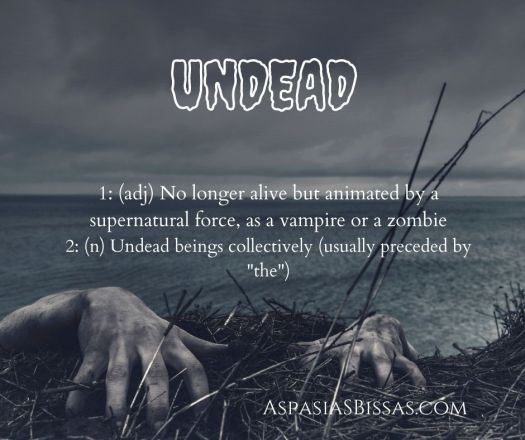
The first use of “undead” was c. 1400, but its use as a noun to mean vampires and other creatures dates from 1904. (Source)
“It’s a reflex. Hear a bell, get food. See an undead, throw a knife. Same thing, really.” -Ilona Andrews, Magic Bites
I know the word exsanguinate from the X-Files episode “Eve,” but it was first used around 1800, coming from the Latin exsanguinatus, meaning bloodless or deprived of blood.
“My first word of the new year was ‘exsanguinate.’ This was probably not a good omen.”
-Charlaine Harris, Dead to the World.
And of course, we can’t forget the word that all the others relate to:
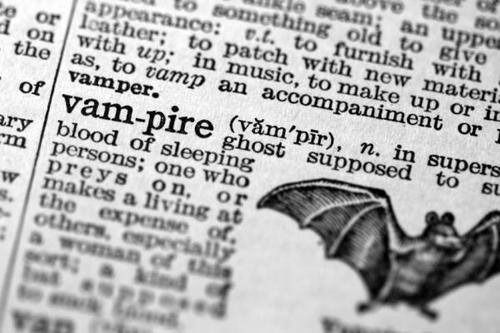
The earliest form of the word “vampire” dates to only 1734, although
stories of monsters that rise from the dead and attack the living can be
found even in ancient times. The idea of blood-gorged walking corpses
goes back to at least the 1100s. There’s some debate as to where the
word comes from, but it most likely has its roots in the Old Church
Slavonic “opiri.” (Source)
“It was too much, the weight of it all was too much. Maybe that was
why emotions were deadened in vampires; the alternative was to be
overtaken by them, crippled, left stranded and isolated and trapped by
unbearable sensation. How could they hunt if they felt sympathy,
empathy, love for their prey? How could they —how could she —live with
themselves?” Aspasía S. Bissas, Love Lies Bleeding
Yes, that’s a quote from my own book (I’m sneaky that way). Get my books to find even more words about vampires:
If you prefer a good paperback to an ebook, use this link to order Love Lies Bleeding from Bookshop – a portion of each sale goes directly to independent bookstores, as well as to myself. Thank you for supporting indie! ♥
Did I miss your favourite word about vampires? Let me know in the comments…
Dragonscale Clippings recently shared a review of Love Lies Bleeding:
Love Lies Bleeding by Aspasia S Bissas Although this novel starts off almost predictably (for a vampire tale) it soon develops into something quite unusual. Read more…
Give it a read, and don’t forget to stop by Dragonscale Clippings’s blog and follow and like! Many thanks for the kind review ♥
Speaking of reviews, if you’ve read and enjoyed any of my books,
please take a minute now to leave a rating or review (links below). And
if you haven’t read my books yet, now is the perfect time to start…
Paperback available from Bookshop
– when you use this link, a portion of each sale goes directly to
independent bookstores, as well as to myself. (It’s also available on
most other online book sites.)
Blood Magic
Myth and magic collide in this story about choices, transformation, and retribution.
Photo by Nichitean Dumitrita Veronica on Pexels.com
Close on the heels of World Goth Day comes World Dracula Day. It
might be sunny springtime where you live, but this is the week to ignore
the singing birds and blooming flowers, and channel your dark side (for
those of you who don’t already do that year round anyway). What better
way to immerse yourself in all things Dracula than by visiting the
places associated with the Count?
(Note: I won’t be including any sites that focus exclusively on Vlad
Dracul/Vlad the Impaler. While he has his own blood-soaked history, his
connection to Stoker’s Dracula, in my opinion at least, doesn’t go much
further than the name.)
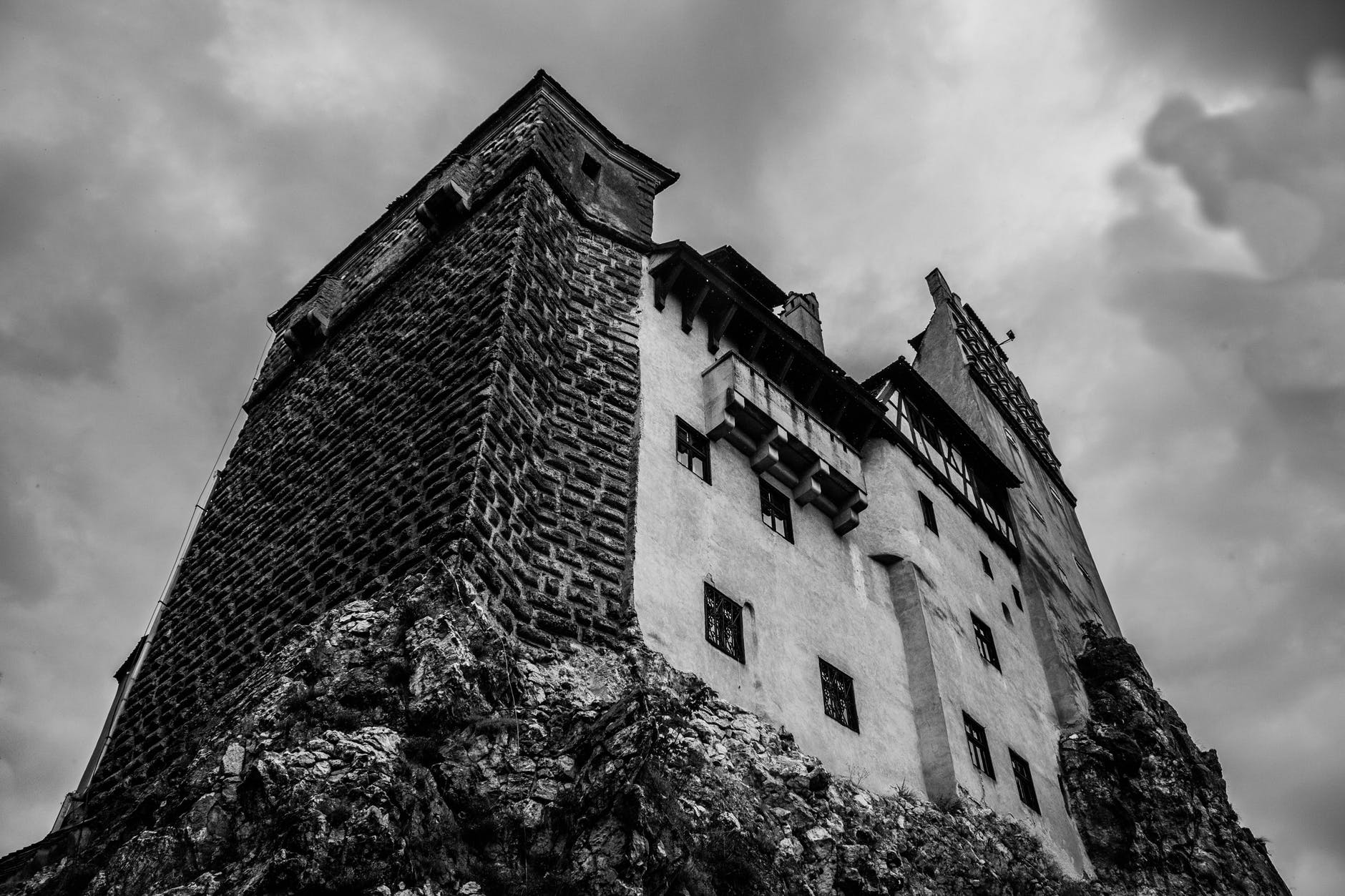
The only castle in Transylvania that fits Stoker’s description, Bran
Castle is widely considered to be “Dracula’s castle.” If the beautiful
building and rich history aren’t enough for you, the castle regularly
offers special exhibitions. If the onsite restaurant is open when
you go, you can try the “Count’s Dessert” (chocolate cake with raspberry
sauce, fresh fruit, and rose petal powder).
After Stoker published Dracula, tourists started showing up
in Transylvania. From the start they were looking to stay in the same
hotel that Jonathan Harker spent a night in (The Golden Crown). The
hotel didn’t exist, but some enterprising soul realized it would be a
great idea to build it. The Coroana de Aur (“Golden Crown” in Romanian)
hotel in Bistrita doesn’t have much in common with the inn Harker
stayed at, but there is a Jonathan Harker Salon at the restaurant. You
can also order authentic Mămăligă (polenta) like Harker ate. No word on
whether they also offer stuffed aubergines.
Live actors and special effects tell the story of Dracula and
how the town of Whitby relates to it. The “Experience” has been
described as a story set in a haunted house, which is appropriate since
the building it’s in is apparently centuries old and haunted. To explore
the building’s ghost sightings and other paranormal activity, a
Paranormal Night takes place the first Saturday of every month (no
special effects here).
The graveyard at St. Mary’s Church is the setting and inspiration for a number of scenes in Dracula.
Try to see how many of the character’s names you can find on the
gravestones (Stoker borrowed a few of them). On the way to the church,
you can climb the 199 steps that a black dog (Dracula in another form)
was seen running up in the book.
And while you’re there make sure to make the 100 metre (340 feet)
trek from St. Mary’s to Whitby Abbey, another source of Stoker’s
inspiration. Explore the ruins before checking out the on-site museum
and shop. The Abbey hosts all kinds of Dracula-themed events, so check the schedule before you go.
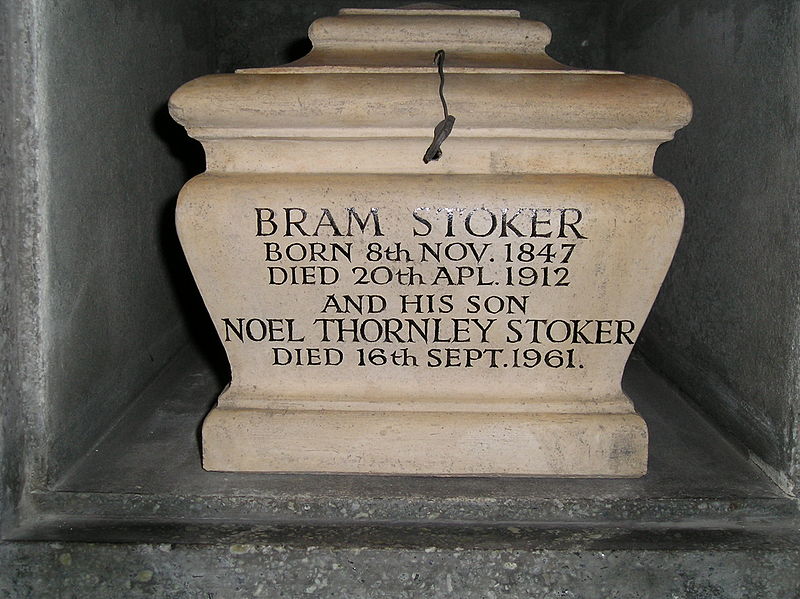
If you’re in London, you can go pay your respects at the final
resting place of the man who brought the world Dracula. You do need to
book ahead because the building is kept locked. If you can’t make it
there in person, you can leave a virtual flower in his honour.
These are just a few of the Dracula-related places to visit, and I
expect more will open as tourism eventually returns to normal. Do you
have a favourite Dracula-themed place or event? Share in the comments…
Don’t forget to give other vampires some love too– download my books today!
If you prefer paperback, use this link to order Love Lies Bleeding from
Bookshop – a portion of each sale goes directly to independent
bookstores, as well as to myself. Thank you for supporting indie! ♥
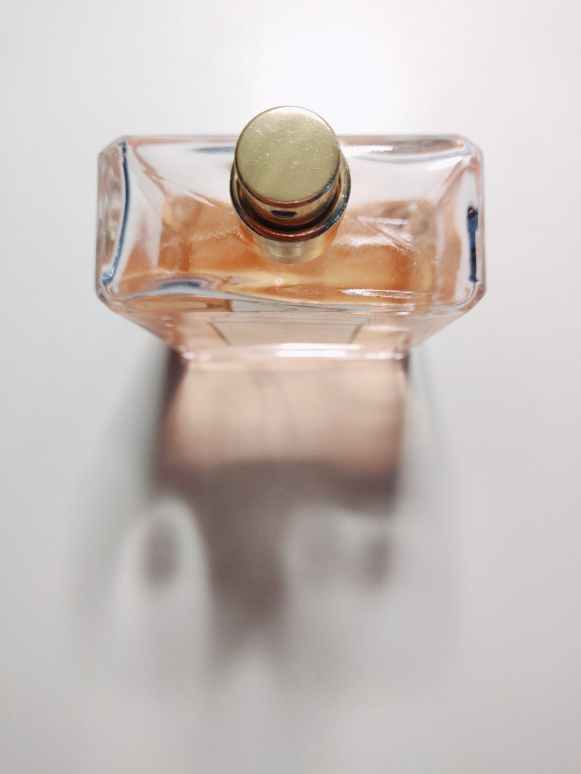
A while back I read an article
about the connection between literature and perfume, which also
included suggestions for ideal perfumes for book lovers. As someone who
has a slight perfume obsession (reigning favourite: Vanilla Extreme by
Comptoir Sud Pacifique), I was intrigued. I especially liked the idea
behind the Imaginary Authors
perfume company, whose scents are based on the fictional exploits of
made-up authors. But if perfume can be designed for fictional authors,
why not design a few for Love Lies Bleeding’s characters?
Since main character Mara works with herbs and
plants, she’s essentially steeped in their scents without needing to
wear perfume. But if I were to create a perfume for her, it would have
strong notes of sweet woodruff (which smells like vanilla and hay),
clover, and lavender flowers, with hints of smoky peat and black tea.
For human Lee, I envision something fresh and
“green.” His scent would be based on cedar, with some kind of
complementary citrus (yuzu, or maybe tangerine), and the subtlest
undertones of honey and lavender leaves.
Lastly, I think a scent heavy on whisky and tobacco notes, with
something spicy like ginger or cloves, would suit vampire nemesis Dominic.
It would be the kind of scent that’s overwhelming in the wrong hands,
but Dominic probably wouldn’t wear it anyway, as it’s one of those
luxuries he doesn’t think vampires should indulge in.
What do you think– would you wear any of these scents? What perfume
would you design for your favourite character or author? Share in the
comments…
Want to find out more about Mara, Lee, and Dominic? Get my books!
If you prefer a good paperback to an ebook, use this link to order Love Lies Bleeding from Bookshop – a portion of each sale goes directly to independent bookstores, as well as to myself. Thank you for supporting indie! ♥
Cheers,
Aspasía S. Bissas
[This was originally posted on my official site AspasiaSBissas.com. Follow me there...]
Love Lies Bleeding‘s
readers know that main character Mara is both a vampire and a botanist.
Trained when she was still human, she continues to study plants and
have a garden. This post is tenth in a series exploring Mara’s plants.
Are you interested in botany, gardening, or plant lore? So are some
vampires…
Please note: Medicinal uses are given for informational purposes
only. Always consult a medical professional before diagnosing or
treating yourself or anyone else.
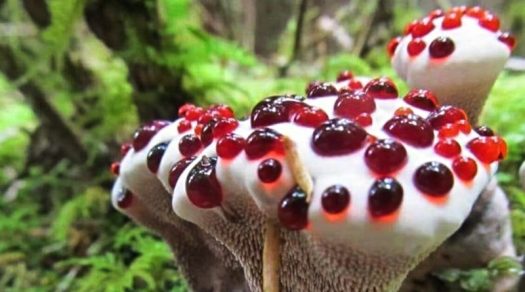
Botanical Name:Hydnellum peckii
Common Names: strawberries and cream, bleeding Hydnellum, bleeding fungus, red-juice tooth, devil’s tooth, Peck’s hydnum, bile tooth
History: Found mainly in North America and Europe,
bleeding tooth fungus forms mutually beneficial relationships with
mature coniferous trees. Its spores are “on the surface of vertical
spines or tooth-like projections that hang from the undersurface of the fruit bodies”
(1). As the fungus ages, it dries out, losing its bloody appearance and
becoming a nondescript shade of brown or black. Bleeding tooth fungus bioaccumulates
the heavy metal caesium. Although documented by humans for only about a
hundred years, bleeding tooth fungus’s roots (no pun intended) go back
hundreds of millions of years.
Language of Flowers Meaning: None
Cultivation: It prefers to grow in mature forested alpine and sub-alpine regions, so cultivating it isn’t really an option.
Uses:
Medicinal: Although scientists aren’t sure what the red substance
that oozes out of bleeding tooth fungus is exactly, they have found that
it contains a pigment with anticoagulant and antibacterial properties.
It also contains another substance that may be beneficial in treating
Alzheimer’s disease. It is currently undergoing trials to determine its
potential medical uses.
Culinary: It’s technically edible (in that it isn’t poisonous), with a
peppery and strongly bitter taste that doesn’t go away even when dried.
While it can be eaten, whether anyone actually wants to eat it is
another matter.
Dye: The dried fungus produces a beige or tan dye. It can also be combined with iron or alum for shades of blue and green.
Mara’s Uses: Mara mentions it in Love Lies Bleeding as a potentially useful plant she needs to learn more about.
If you prefer a good paperback to an ebook, use this link to order Love Lies Bleeding from Bookshop – a portion of each sale goes directly to independent bookstores, as well as to myself. Thank you for supporting indie! ♥